Category Archives: Vmware

Force Vmware VM to boot from CD

  • Edit the machine settings:

VM_EditSettings

  • Go to Options tab, select Boot Options, and then Force BIOS Setup:
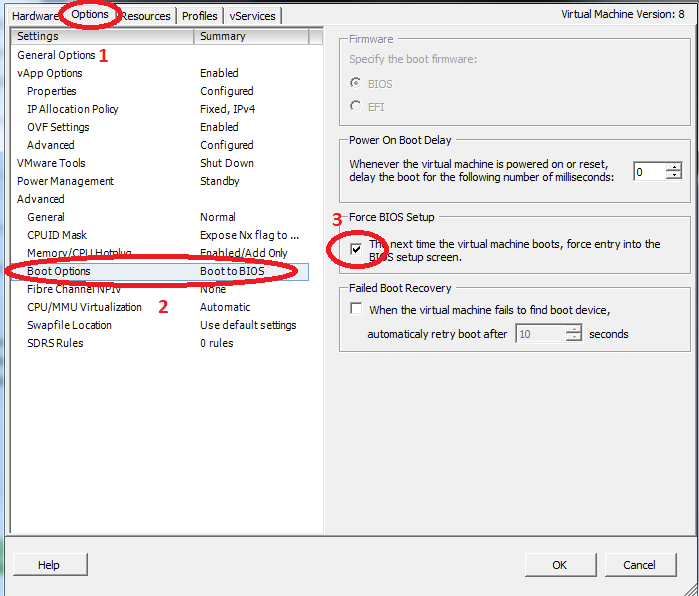
VM_BootToBios

  • In the BIOS go to “Boot” tab, Then stand on the “CD-ROM Drive” and hit the “+” in the keyboard to get the CD-ROM to be first, and hit F10 to save and restart


VM_BiosBootOrder

Unable to contact the specified host

Vmware converter -  P2V error : “Unable to contact the specified host; The host is not available…”

image


Check the following:


1. Ports:

Open ports between the convertor server to the Source computer – 445, 139, 9089 or 9090

Open ports between the convertor server and VC  – 443, 902

Open ports between the Converter client and the Converter server 443

open ports between the Source computer and  ESXi 443,902

2.Make sure that  the user is part of the local administrator’s group on the Source computer

3. VSS service is running on the windows physical machine

In my case it was anti virus issue – as soon as I unload the trend micro agent on the server everything worked.  Smile

VMware: ESXi requires the Execute Disable/No Execute CPU feature to be enabled – HP DL360 G5

Error:

While installing Esxi 5.5  I received the following warning message:

“The system has found a problem on your machine and cannot continue.
VMware ESXi requires the Execute Disable/No Execute CPU feature to be enabled”

image

Solution:

1.Restart the host
2. press F9 to boot in BIOS mode
3. Advanced Options –> Processor Options –> No-Execute Memory Protection –> configure: Enabled

image

Use PowerCLI to Backup and Restore ESXi Host Configuration

The following post will guide you through the steps necessary to backup Esxi host configuration with PowerCLI

Steps :

1. first you need to download the vSphere PowerCLI – installer

2. Open Powershell and Type: Add-PSSnapin VMware.VimAutomation.Core
Or, for all commands, run the script:
"C:Program Files (x86)VMwareInfrastructurevSphere PowerCLIScriptsInitialize-PowerCLIEnvironment.ps1"

3. Connect to the Server : Type "Connect-VIServer" and type server IP and credentials

image

4. Backup:

get-vmhost "Host.Domain.local"| get-vmhostfirmware -BackupConfiguration -DestinationPath “C:\BackupHost”

*BackupHost is a directory that I created, you can put any path where you want the backups to be stored.

5.Restore:

Get-vmhost “Host.Domain.local” | Set-VMHostFirmware -Restore -DestinationPath C:download

Or whereever you stored the backup config.